Cetic.br gathers national and international experts to discuss challenges of statistics production in the era of artificial intelligence
Notas
01 SET 2026
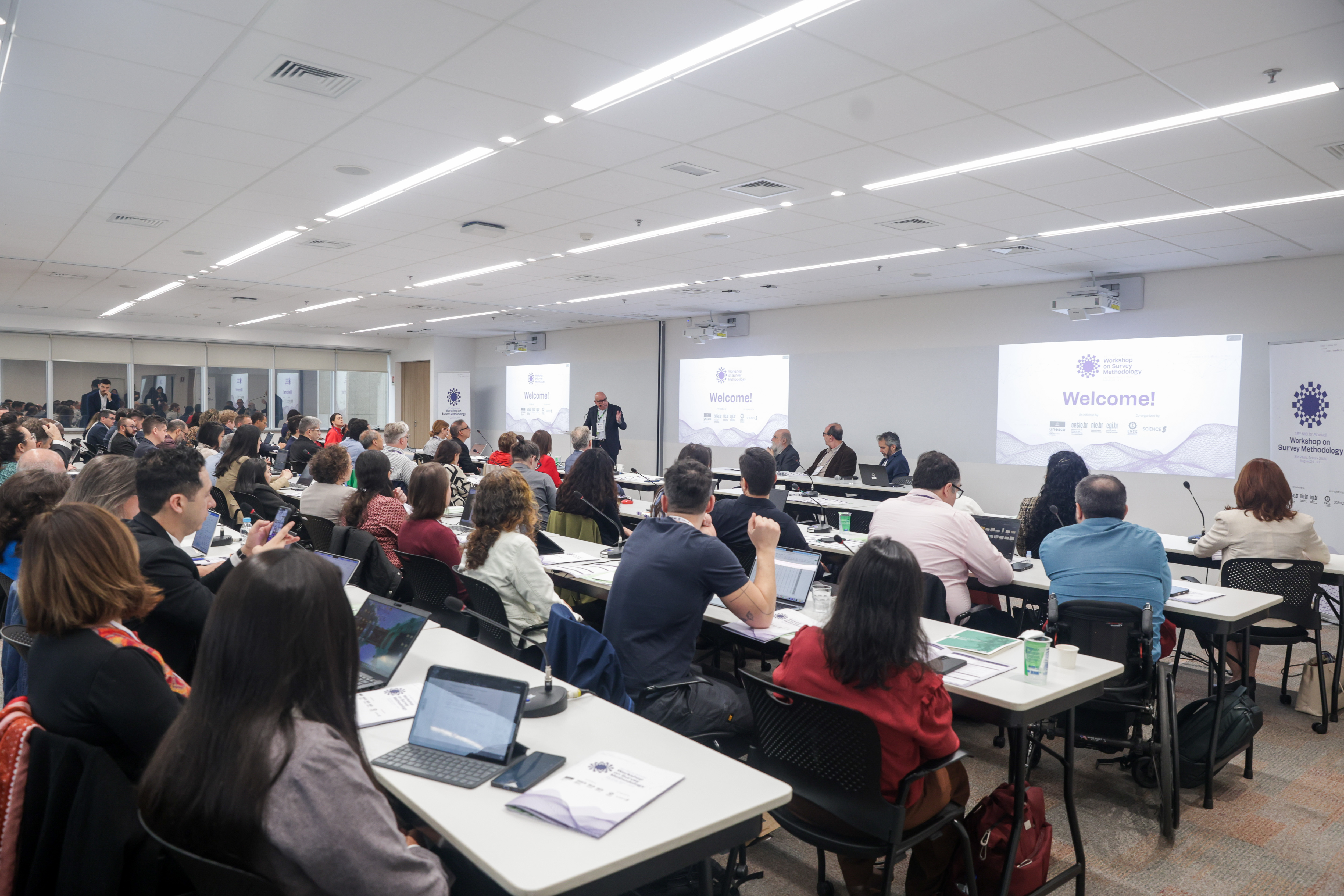
16th edition of the Annual Workshop on Survey Methodology discussed new data sources, data governance, cybersecurity, digital economy, and the use of AI and machine learning in the context of the action of national statistics producers
São Paulo, September 1, 2026 – The impacts of artificial intelligence (AI), the incorporation of new data sources, and the challenges of ensuring the quality and reliability of statistics in a rapidly transforming digital ecosystem were at the center of the debates at the 16th edition of the NIC.br Annual Workshop on Survey Methodology, held from August 24 to 27, in São Paulo (SP).
Promoted by the Regional Center for Studies on the Development of the Information Society (Cetic.br) of the Brazilian Network Information Center (NIC.br), in partnership with the National School of Statistical Sciences (ENCE) of the Brazilian Institute of Geography and Statistics (IBGE) and the Society for the Development of Science (SCIENCE), the meeting brought together experts from national statistical institutes, academia, ministries, regulators, and international organizations.
In the opening session, Demi Getschko, CEO of NIC.br, highlighted the trajectory of Cetic.br in the production of information to support decision-making: "Cetic.br has over 20 years of experience conducting surveys and producing reliable and internationally comparable results that help guide public policies in Brazil". Alexandre Barbosa, manager of Cetic.br, emphasized that technological changes require greater cooperation among data producers: "We are living in a time of rapid digital transformation due to the adoption of new technologies, especially artificial intelligence, with a significant impact on the production of statistics. In this scenario, there is no other way but to collaborate, share experiences and build robust solutions together. This increasingly leads us to the need for cooperation between institutions," he stated.
The new data sources used in the production of official statistics were addressed by Professor Elisabetta Carfagna from the University of Bologna (Italy). The professor discussed how information from administrative databases, satellite images, the Internet, and other sources can complement traditional surveys, provided they are accompanied by methods to assess quality, coverage, and representativeness. Using practical examples, the specialist pointed out that integrating different sources impacts the results more than the complexity of machine learning algorithms. "Official statistics no longer hold the exclusive centrality in producing information about society. Today, different data sources and information producers coexist and compete for attention, legitimacy, and trust. In this new context, the role of official statistics continues to be to provide society with reliable knowledge about itself. The reason for the existence of this statistical system remains valid, but its forms of production, dissemination, and interaction with users need to be profoundly transformed," noted Carfagna.
In the discussion on data governance in the age of AI, Stefaan G. Verhulst, from The Governance Lab (United States), addressed the necessary changes in the face of AI systems capable not only of producing inferences but also of executing actions. Among the proposals, he advocated for purpose-driven governance, starting with specific questions and problems, rather than being solely determined by the available data. This approach allows identifying which data are necessary and establishing appropriate rules, responsibilities, and safeguards for their use. "We need to start with the questions. It's necessary to define what the question is and what the purpose is, and then determine which data are necessary and how to govern them. Without specifying the purpose, good governance is not possible," emphasized Verhulst.
Another challenge in the production of statistics discussed during the workshop was the production of statistics on cybersecurity. Éireann Leverett from the University of Cambridge (UK) showed that the measurement of cyber risk varies depending on the population used as a reference. When comparing universes such as vulnerabilities, software versions, domains, IP addresses, packets, and data volume, the presentation identified a range of about 18 orders of magnitude among the analyzed universes. According to Leverett, it is not enough to count events: to estimate their frequency or probability, it is necessary to relate them to the size of the analyzed population. "To obtain a probability, I truly need a ratio. Without it, I cannot arrive at a frequency, I cannot arrive at a probability," he explained.
The necessary transformations for national statistics producers were discussed by Wesley Yung, former director of Statistics Canada. Faced with the multiplication of sources and the demand for more detailed and faster data, the specialist addressed the need to incorporate new methods and technologies while preserving the principles that sustain the quality and trust in official statistics. "The status quo is not an option. We need to evolve, but that does not mean abandoning what sustains official statistics. The challenge is to leverage new tools without losing sight of society's trust in the data we produce," he emphasized.
About the program
The four-day program brought together panels, tutorials, case studies, thematic sessions, and a short-term course. Among the topics addressed were the use of AI and machine learning in surveys, quality in ecosystems with multiple data sources, Indicators of Internet Universality, information integrity, digital economy, digital infrastructure, measurement of the AI economy, and the use of mobile phone data in the production of official statistics.
The activities included experts from institutions like UNESCO, International Telecommunication Union (ITU), Economic Commission for Latin America and the Caribbean (ECLAC), United Nations Conference on Trade and Development (UNCTAD), Organisation for Economic Co-operation and Development (OECD), International Monetary Fund (IMF), National Institute of Statistics of Portugal, Federal Statistical Office Germany, The GovLab, and the Universities of Bologna in Italy, Cambridge in the UK, Michigan in the United States.
The NIC.br Annual Workshop on Survey Methodology has been held since 2011 by Cetic.br|NIC.br, in collaboration with ENCE | IBGE and SCIENCE, as a space for exchanging experiences and developing capacities among data producers and users, researchers and experts, focusing on emerging topics and methodological innovations.
About Cetic.br
The Regional Center for Studies on the Development of the Information Society (Cetic.br), of NIC.br, is responsible for producing indicators and statistics on Internet access and use in Brazil, publishing periodic analyses and information on the network's development in the country. Cetic.br|NIC.br is also a Regional Center for Studies under the auspices of UNESCO and will complete 20 years of operation in 2025. More information at https://cetic.br/.
About the Brazilian Network Information Center – NIC.br
The Brazilian Network Information Center — NIC.br (https://nic.br/) is a private, non-profit civil entity responsible for the operation of the .br domain, as well as the distribution of IP numbers and the registration of Autonomous Systems in the country. NIC.br implements the decisions and projects of the Brazilian Internet Steering Committee - CGI.br since 2005, and all revenue comes from its activities, which are of a private nature. It conducts actions and projects that benefit the Internet infrastructure in Brazil. NIC.br includes: Registration.br (https://registro.br), CERT.br (https://cert.br/), Ceptro.br (https://ceptro.br/), Cetic.br (https://cetic.br/), IX.br (https://ix.br/) and Ceweb.br (https://ceweb.br), as well as projects like Internetsegura.br (https://internetsegura.br) and Brazil's Best Practices for the Internet Portal (https://bcp.nic.br/). It also hosts the office of the W3C Chapter São Paulo (https://w3c.br/).
About the Brazilian Internet Steering Committee – CGI.br
The Brazilian Internet Steering Committee, responsible for establishing strategic guidelines related to the use and development of the Internet in Brazil, coordinates and integrates all Internet service initiatives in the country, promoting technical quality, innovation, and dissemination of the services offered. Based on the principles of multistakeholderism and transparency, CGI.br represents a democratic Internet governance model, internationally praised, where all sectors of society participate equally in its decisions. One of its formulations is the 10 Principles for Internet Governance and Use (https://cgi.br/resolucoes/documento/2009/003). More information at https://cgi.br/.
Press information
NIC.br Press Office - nic@maquinacohnwolfe.com
Luciana Minami – Luciana.minami@agenciamaquina.com – (11) 99140-4204
Fernanda Sátiro – fernanda.satiro@agenciamaquina.com – (11) 99203-7650
Vanessa Campos – vanessa.campos@agenciamaquina.com – (61) 8167-0790
Communication Office – NIC.br
Carolina Carvalho - Communication Manager - carolcarvalho@nic.br
Ana Nascimento - Communication Coordinator – ananascimento@nic.br
Flickr: https://flickr.com/NICbr/
X: https://x.com/comuNICbr/
YouTube: https://youtube.com/nicbrvideos
Facebook: https://facebook.com/nic.br
Telegram: https://telegram.me/nicbr
LinkedIn: https://linkedin.com/company/nic-br/
Instagram: https://instagram.com/nicbr/
This content was automatically translated with the support of artificial intelligence.
Cetic.br and Unesco
In 2012, Cetic.br became a UNESCO Category 2 Center, the first of its kind dedicated to the development of information and knowledge societies. The Center is linked to the Communication and Information (CI) Sector, one of UNESCO’s five areas of work. It contributes to achieving the organization’s strategic objectives by strengthening its efforts to monitor the building of information and knowledge societies. Cetic.br’s scope of action includes Latin America and the Portuguese-speaking countries of Africa.
Learn about our work